Transparent screening you can actually explain
A job post now draws hundreds of applications, most of them AI-written. SiftFirst ranks the whole pile against a rubric you control and shows the evidence behind every score. It assists your judgement; it does not replace it.
Paste the job and the applications
Drop in the job description and the pile of resumes: paste text, or upload PDFs, DOCX, a ZIP, or a CSV. No integration or setup.
Set the rubric
SiftFirst suggests criteria from your job post; keep them, edit them, or add your own, then weight what matters with sliders. The rubric is yours, not a hidden model.
Get a ranked, explainable shortlist
Every candidate is scored against the rubric with quoted evidence, ranked into a shortlist you can re-weight, compare, and export.
How the scoring works
Each candidate is scored from 0 to 10 on every criterion in your rubric, and each score comes with a short quote from the resume that supports it. The model never invents qualifications; if the evidence is not there, the score is low and says so.
The overall score (0 to 100) is a plain weighted average of those per-criterion scores using your weights. It sorts candidates into a starting shortlist: 70 and above is shortlist-grade, 45 to 69 is a maybe, below that is a likely pass. These are a starting point for your review, never a verdict.
Change a weight and the whole ranking updates instantly, no re-run and no extra cost, because the per-criterion scores are fixed and only the weighting changes.
- Python experience9
- PostgreSQL depth7
- Production REST APIs7
- Team leadership4
Evidence, not a black box
Every ranking is auditable. Open any candidate and you see the exact resume text behind each score, so you can check the reasoning and overrule it. Nothing is hidden in a model you cannot inspect.
The AI-written-resume signal
SiftFirst quietly flags resumes that read as AI-generated, as a prompt to look closer, never an automatic reject. It is an internal signal, not a public badge or a score penalty.
Why so careful: clean, generic writing is not proof of anything, and auto-rejecting on it would unfairly hit non-native and concise writers. You decide what, if anything, it means. The same detector is free to try as the AI resume detector.
You make every hiring decision
SiftFirst is a ranking assistant. You set the criteria, you read the evidence, and you make every call. Keeping a human in the loop is the design, not an afterthought, which matters as hiring tools come under closer scrutiny for fairness.
See the whole pool at a glance
Beyond the ranked list, the analytics view shows how your candidates spread on each criterion and gives a plain-language read on the pool: whether you have enough strong candidates to interview, and where it is thin.
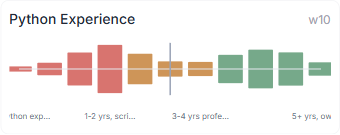
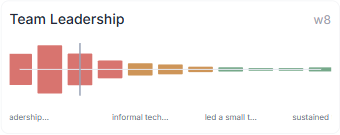
Each dot is a candidate, colored by how well they meet the criterion; the axis reads in real terms, not just 0 to 10. Click a candidate to spotlight them across every chart (shown highlighted here).
Once a pile is too big to read dot by dot, each chart becomes a density curve so the shape stays clear. Different criteria spread differently, which is the whole point: Python experience splits into juniors and seniors, while leadership is thin across the board.
The heatmap lays the whole rubric out at once: rows are candidates, columns are your criteria, each cell colored by the score.
| Python | Postgres | REST | Leadership | |
|---|---|---|---|---|
| A. Chen | 9 | 8 | 8 | 6 |
| M. Silva | 7 | 6 | 7 | 3 |
| K. Patel | 5 | 5 | 6 | 2 |
| J. Okafor | 3 | 4 | 3 | 1 |
6 of 40 are shortlist-grade (score 70+), 22 borderline, median 58/100.
A few strong candidates, but the pool is thin on senior Python and leadership. Interview the top tier now and consider widening sourcing for senior backend experience.
Sample figures shown for illustration.
Your data
Screenings you run signed out are not stored. Signed in, your screenings are saved to your private history so you can revisit them, and you can delete your account and everything in it at any time. We do not sell your data.